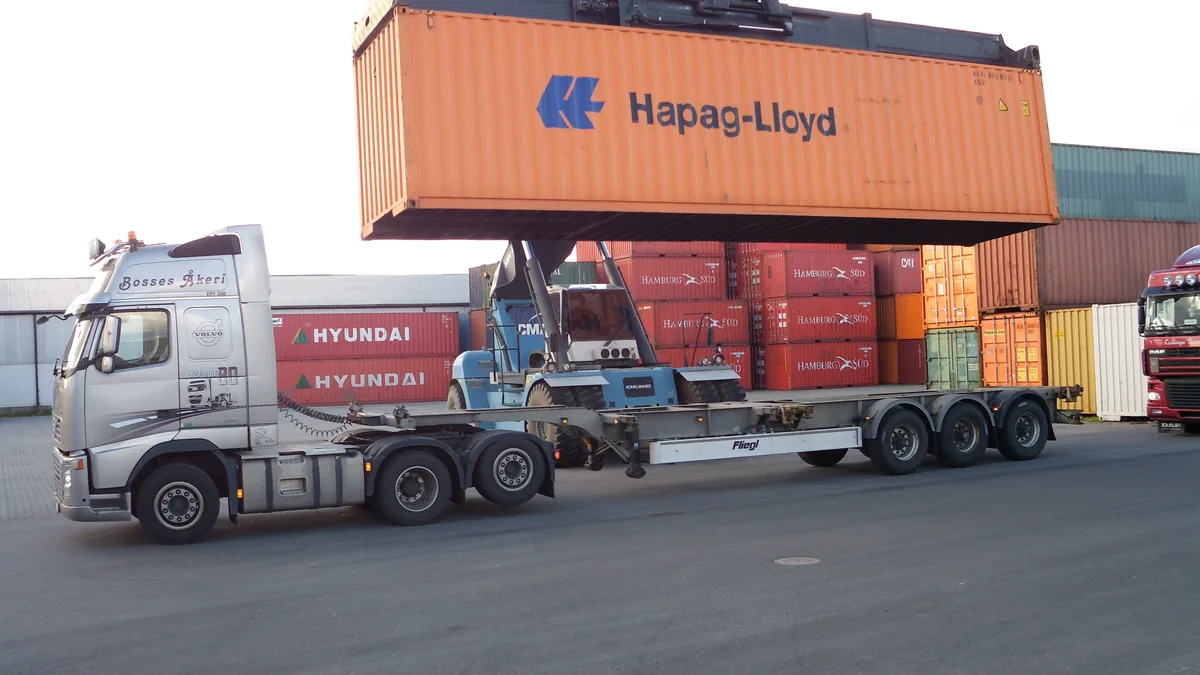
Which GHG Protocol category your cargo falls under, which data to request for each leg and why it pays to receive it through an integration instead of a spreadsheet.
Scope 3 Category 4 covers the emissions from trucks, ships and planes your company does not own that move the goods you buy, along with any freight service you purchase. Together with Category 9 for sold goods, it is where importers and exporters report the scope 3 emissions of their cargo, calculated leg by leg under ISO 14083 and the GLEC Framework.
This article, first published in December 2025 about the CarbonTracker API, has been updated to explain which category applies to you, which data to request from your freight forwarder, how a transport leg is calculated and what changes when that data arrives through an integration.
Contents
- What scope 3 transportation emissions are
- Category 4 or Category 9, depending on who pays the freight
- What ISO 14083 and the GLEC Framework add
- The three GHG Protocol calculation methods
- How a shipment is calculated leg by leg
- What data to request from your forwarder for each shipment
- Why integrate the data through an API instead of a spreadsheet
- Who will ask you for this report
- Common mistakes when reporting transportation
What scope 3 transportation emissions are
The GHG Protocol splits a company's emissions into three scopes. Scope 1 covers owned or controlled sources and scope 2 purchased energy such as electricity. Scope 3 covers the value chain in 15 categories defined by the Corporate Value Chain (Scope 3) Standard, released in 2011.
In transportation the boundary is simple. If your company owns the truck, its fuel goes into your scope 1. If a shipping line, an airline or a contracted carrier moves the freight, those emissions are their scope 1 and 2, and you report them as scope 3.
Delpa Tecnología covers the broader picture in what green logistics is and how to measure it. This article has a narrower focus, how to report the scope 3 emissions generated by moving your cargo, one shipment at a time.
Category 4 or Category 9, depending on who pays the freight
Category 4, upstream transportation and distribution, includes moving what you buy from your direct suppliers to your own operations in vehicles you do not own. It also includes every transportation service your company purchases, whether inbound, outbound or between your own facilities.
Category 9, downstream transportation and distribution, covers moving what you sell after the point of sale in vehicles you neither own nor pay for. If you purchase the outbound freight, it goes into Category 4 rather than 9, because it is a purchased service.
In international trade, the Incoterm of the sale sets who buys the main freight, as our Incoterms guide explains term by term. The table applies the Category 4 and 9 definitions to the most common Incoterms. The GHG Protocol does not mention Incoterms, so this is our reading and worth confirming with your verifier.
| Incoterm | Who pays the main freight | Category for the exporter |
|---|---|---|
| EXW | The buyer, from the seller's premises | Category 9 for all transportation |
| FOB | The buyer, once the goods are on board | Category 4 up to the port of loading, Category 9 after that |
| CFR and CIF | The seller, up to the port of destination | Category 4 up to the port of destination, Category 9 after that |
| DAP and DDP | The seller, up to the place of destination | Category 4 up to the place of destination, Category 9 for any later distribution it does not pay for |
For the importer, inbound freight falls under Category 4 under any term. What changes is who holds the data. If you book the freight, your forwarder provides it. If your supplier books it, you will need to ask the supplier.
A frequent mix-up is transportation between your direct supplier and that supplier's own supplier. That leg does not belong in Category 4, because the GHG Protocol treats it as part of the emissions of purchased goods, in Category 1.
What ISO 14083 and the GLEC Framework add
The GHG Protocol tells you which category each emission belongs to. How transportation emissions are quantified is set by ISO 14083, published in March 2023, which establishes a common methodology for the quantification and reporting of greenhouse gas emissions from the operation of passenger and freight transport chains.
The Smart Freight Centre's GLEC Framework is the industry reference methodology for harmonized calculation and reporting of the logistics footprint. Version 3.3, released in October 2026, states that it is aligned with ISO 14083 and the GHG Protocol (Smart Freight Centre, 2026).
| Framework | What it settles | Source |
|---|---|---|
| GHG Protocol, Scope 3 Standard (2011) | Which scope and category each value chain emission is reported in | GHG Protocol |
| ISO 14083:2023 | A common methodology to quantify and report transport chain emissions | ISO |
| GLEC Framework 3.3 (2026) | Harmonized calculation and reporting of the logistics footprint, aligned with ISO 14083 | Smart Freight Centre |
The three GHG Protocol calculation methods
The GHG Protocol technical guidance for Category 4 allows three methods (GHG Protocol, Scope 3 Calculation Guidance). They differ in their starting data, not in the category where the result is reported.
| Method | Starting data | When it fits |
|---|---|---|
| Fuel-based | Fuel consumed by the carrier, multiplied by the emission factor of each fuel | When the vehicle carries only your goods, such as a full truckload, or consumption can be allocated to your cargo |
| Distance-based | Mass or volume of the cargo times the distance of each leg, multiplied by the mode or vehicle factor | When the cargo travels consolidated or you lack fuel data from the carrier |
| Spend-based | Amount spent on transport, multiplied by economic (EEIO) factors | When you have no physical shipment data |
According to the same guidance, the fuel-based method is more accurate for CO₂ because fuel consumption is directly related to emissions. The distance-based method is less accurate, since it assumes average consumption, loads and utilization, but it works when you share the vehicle with other cargo.
How a shipment is calculated leg by leg
With the distance-based method, a shipment's emissions are the sum of its legs. For each leg, the mass of the cargo in tonnes is multiplied by the distance traveled in kilometers and by the emission factor of the mode, expressed in kg CO₂e per tonne-kilometer.
In ocean freight the factor is often expressed per TEU-kilometer, that is, one twenty-foot container moved one kilometer. The guidance asks for each leg to be calculated separately because each mode has its own factor.
Consider a container shipped from Shanghai to San Antonio, Chile, then trucked to a warehouse in Santiago. That is at least two legs, one by sea and one by road, plus any transshipment along the way.
| Leg | Activity data | Factor applied |
|---|---|---|
| Ocean, port of origin to port of destination | TEU or tonnes, actual port-to-port distance | kg CO₂e per TEU-km or per t-km for the vessel type |
| Road, port to warehouse | Tonnes, actual truck kilometers | kg CO₂e per t-km for the truck type |
| Air, if any | Tonnes, flight distance | kg CO₂e per t-km for the aircraft type |
The guidance asks you to use the actual distance reported by the carrier. Only when it is unavailable does it accept the shortest theoretical distance, online maps or published port-to-port distances.
What data to request from your forwarder for each shipment
A calculation is only as good as its data. Before year-end, ask your freight forwarder for the information your chosen method requires, shipment by shipment.
- Gross or chargeable weight of the cargo, plus the number and size of containers.
- Ports or airports of origin and destination, with any transshipments.
- Actual distance of each leg, or the route needed to calculate it.
- Mode of each leg with the type of truck, vessel or aircraft.
- Whether the vehicle was dedicated or shared, to choose between the fuel-based and distance-based methods.
- The carrier's fuel consumption, when available.
Much of that data already appears in the shipping documents, such as the bill of lading. Delpa Group handles import and export shipments, as well as ocean freight for containers.
Why integrate the data through an API instead of a spreadsheet
With a few shipments a year, a spreadsheet will do. With hundreds, copying weights, routes and modes by hand multiplies errors and pushes the report back to the end of the fiscal year.
The alternative is for the system that already records each shipment to send that data to the calculation engine through an API. It can be the ERP, the transportation platform or IoT sensors. That way each shipment, movement and route reports its CO₂ with no manual input.
That is the approach of CarbonTracker, the Delpa Tecnología platform. According to its site, it offers a complete REST API to integrate with ERP, IoT and other enterprise platforms, with calculations based on the GHG Protocol and the 2023 ISO 14083 standard.
Its press coverage is summarized in our article on CarbonTracker in Revista Negocios Globales. Whatever tool you choose, check that it shows the calculation for each leg with the factor used, because that is what makes the result reviewable.
Who will ask you for this report
Companies reporting under the ISSB's IFRS S2 must disclose their absolute gross scope 1, 2 and 3 emissions, measured under the GHG Protocol unless a jurisdictional authority or an exchange requires a different method. They must also state which scope 3 categories they include, although in the first year they apply the standard they may omit scope 3.
If your customer reports that way, the transportation of what you sell them falls into their Category 4, whoever pays the freight. That is why they may ask you for shipment data even if your company is not required to report.
Common mistakes when reporting transportation
- Reporting outbound freight paid by your company in Category 9. As a purchased service, it belongs in Category 4.
- Adding transportation between your supplier and that supplier's supplier to Category 4, when it belongs in Category 1.
- Using a single average distance for the whole shipment instead of calculating each leg with its own mode.
- Applying the fuel-based method to consolidated cargo without allocating fuel among the shipments that traveled together.
- Adding up shipments calculated with different methods without recording which one was used.
A good report keeps the activity data, the factor and the source of each leg traceable. That way any reviewer can redo the calculation of a shipment.
Frequently asked questions
What is Scope 3 Category 4?
It is upstream transportation and distribution in the GHG Protocol. It covers moving purchased goods from your direct suppliers to your operations in vehicles you do not own, plus any transportation service your company buys, whether inbound, outbound or between your own facilities.
Does an importer report international freight in Category 4 or Category 9?
In Category 4. The GHG Protocol includes there the transportation of what you buy from your direct supplier to your operations in vehicles you do not own. What the Incoterm changes is who holds the freight data.
When does an exporter use Category 9?
When the transportation of what it sells happens after the point of sale in vehicles it neither owns nor pays for, such as the main freight in an EXW or FOB sale. If it buys the freight, as under CIF or DAP, that leg goes in Category 4 and any later leg it does not pay for goes in Category 9.
What formula is used to calculate the emissions of a leg?
Under the GHG Protocol distance-based method, multiply the mass of the cargo in tonnes by the kilometers of the leg and by the emission factor of the mode, in kg CO₂e per tonne-kilometer. In ocean freight the factor is often expressed per TEU-kilometer.
What is the difference between ISO 14083 and the GHG Protocol?
The GHG Protocol defines which scope and category each value chain emission is reported in. ISO 14083, published in 2023, establishes a common methodology to quantify and report emissions from freight and passenger transport chains. They are used together.
What is the GLEC Framework?
It is the Smart Freight Centre's methodology for harmonized calculation and reporting of the logistics greenhouse gas footprint. Version 3.3, released in October 2026, states that it is aligned with ISO 14083 and the GHG Protocol.
What data do I need from my forwarder to calculate scope 3 emissions?
For each shipment, the weight or containers, the ports or airports with any transshipments, the actual distance of each leg, the mode and the vehicle type. If the cargo traveled alone in the vehicle, the carrier's fuel consumption also works.