From tracking to knowledge: a digital ecosystem that empowers people and anticipates every decision.
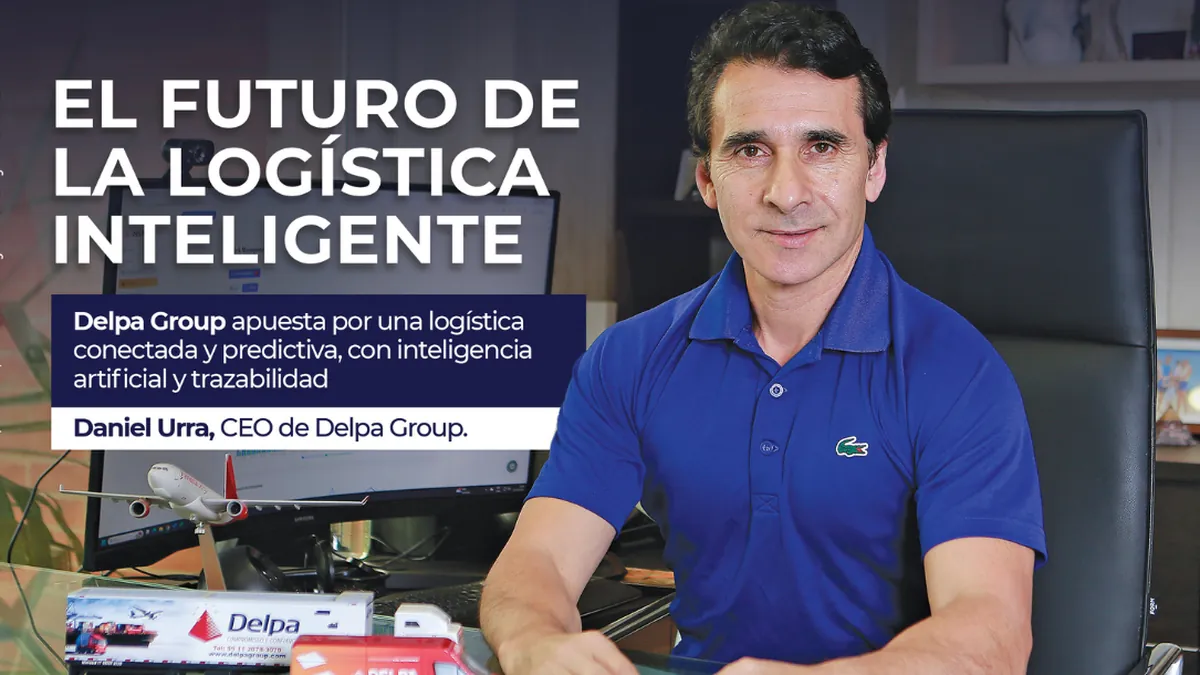
Daniel Urra, CEO of Delpa Group, argues that a logistics operator's value no longer lies only in moving cargo, but in what it does with the data from every shipment. He made the case in an interview that Delpa Group published in the October 2025 issue of Negocios Globales magazine, on pages 14 and 15 of the Smart Tracking special section.
This article summarizes the topics of that interview with short quotes from the CEO. It also explains what his ideas mean for a company that imports into or exports from Chile and needs to know what is happening with its cargo at all times.
Contents
- The interview in Negocios Globales magazine
- From moving cargo to moving information
- What the CEO means by Smart Tracking
- The technology behind tracking
- Efficiency and benefits for customers
- The indicators Delpa Group uses to measure its operation
- Toward cognitive logistics
- What sets Delpa Group apart, according to its CEO
The interview in Negocios Globales magazine
Negocios Globales is a monthly magazine published by Editora Microbyte and focused on logistics and transportation. According to its masthead, it reaches decision makers in logistics, operations and general management in sectors such as mining, retail and agribusiness.
The October 2025 issue includes a special section on Smart Tracking. Delpa Group published the interview with its CEO in that section, on pages 14 and 15, which the magazine's advertiser index lists under the company.
The interview was published in Spanish in the Innovation and Leadership section. The quotes below are Delpa Group's English translation of the printed text, which can also be read in the digital edition of the magazine.
From moving cargo to moving information
Urra describes Delpa Group as a company driving the shift from traditional logistics to digital logistics, connecting domestic and international operations under a single vision. Its stated purpose is to help companies leave fragmented models behind.
He closes that answer with a line that sums up his position. “Leadership is not just about moving cargo, but about moving information, intelligence and opportunities.”
For importers and exporters, the idea has a practical reading. A forwarder is no longer judged only on the freight rate, but also on the quality and timeliness of the information it provides about each shipment.
What the CEO means by Smart Tracking
“For us, Smart Tracking is much more than knowing where a shipment is,” Urra says. In his view, tracking should help anticipate deviations, optimize resources and give customers a proactive experience.
According to the interview, the company integrates GPS, IoT and logistics platform data into a digital ecosystem where carriers, customers and operators interact in real time. The CEO frames it as a way to democratize information across the supply chain.
“The future of logistics belongs to those who use technology to see beyond the route and create value with data,” he adds.
The difference from traditional tracking is when the data arrives. A deviation alert before arrival lets a shipper reschedule a port pickup, warn the end customer or get customs paperwork ready earlier.
The technology behind tracking
The CEO lists the building blocks of the system. He mentions GPS, IoT, RFID and artificial intelligence connected to WMS and ERP systems through REST APIs and WebSocket channels.
“This infrastructure enables a seamless connection among all logistics players, building an intelligent network that learns, predicts and acts,” he explains.
According to Urra, the system runs on OmniCarrier, Moving Truck and Last Mile. OmniCarrier and Moving Truck belong to Delpa Tecnología, the group's software company, while Last Mile is presented on Delpa Group's logistics platforms page.
He insists the tool is not the goal. “For us, technology is a means to anticipate and unlock human potential.”
Efficiency and benefits for customers
Urra argues that real-time information should be available to customers, carriers and operators without depending on office hours or intermediaries. With AI and IoT sensors, he adds, companies can anticipate deviations, optimize routes and cut waiting times.
“This evolution drives more collaborative, agile and sustainable logistics, where decisions rest on accurate data rather than estimates,” he sums up.
Among the results seen by customers, he lists shorter waiting times, optimized routes, higher productivity and lower logistics costs. The interview gives no figures for those results, so they are presented here as the CEO's statement.
For him, the deepest impact is human, because “people now have more time to think and create instead of chasing data.”
The indicators Delpa Group uses to measure its operation
Urra explains that the company's Smart Control Towers track indicators such as OTIF (On Time In Full), SLA, ETA accuracy, waiting times, fleet utilization and customer satisfaction (NPS). This data is managed in real time and triggers automatic alerts.
His conclusion fits in a few words. “Measuring well means leading better.”
That list works as a checklist for any company evaluating its logistics provider. Asking how it measures punctuality, how often it updates the ETA or which alert it sends when a shipment deviates says more than comparing rates.
Toward cognitive logistics
Asked about the future, Urra describes a shift from seeing what happens to predicting and acting autonomously. “We see it evolving toward cognitive logistics, where AI will be at the heart of every decision.”
According to the interview, the next generation of Smart Tracking will add machine learning, computer vision, prescriptive automation and a digital carbon footprint. The goal he sets is to unify all transport modes in a single platform.
In that vision, the system does not just report what happened. It analyzes large volumes of data to foresee delays and recommend immediate actions.
What sets Delpa Group apart, according to its CEO
At the end of the interview, Urra sets Delpa Group apart from other operators. “While others manage transportation, we manage information and decisions, integrating technology, data and people in a single connected ecosystem.”
He also highlights equal access to information for every player in the chain, from a manager to a driver. He closes with a definition of innovation. “Innovating is not reacting to change, but creating it.”
Delpa Group works as a freight forwarder in Chile with over 30 years of experience, its own offices in more than 15 countries and a network of correspondent agents in more than 100 destinations.
Its vision and values are on the About us page. First-time importers can start with the Chile import guide.
Frequently asked questions
Who is Daniel Urra?
Daniel Urra is the CEO of Delpa Group, the title under which he appears in the interview the company published in the October 2025 issue of Negocios Globales magazine. In it he explains how the company uses Smart Tracking, advanced analytics and artificial intelligence in its logistics operation.
What does Smart Tracking mean for Delpa Group?
For Daniel Urra, CEO of Delpa Group, it is much more than knowing where a shipment is. It means integrating GPS, IoT and logistics platform data to anticipate deviations, optimize resources and offer customers a proactive, reliable experience.
Which platforms does Daniel Urra mention in the interview?
He names OmniCarrier, Moving Truck and Last Mile as the platforms where the Smart Tracking system runs. OmniCarrier and Moving Truck belong to Delpa Tecnología, the group's software company, while Last Mile is presented among Delpa Group's logistics platforms.
Which indicators does Delpa Group use to measure its operation?
According to the interview with Daniel Urra, its Smart Control Towers track OTIF (On Time In Full), SLA, ETA accuracy, waiting times, fleet utilization and customer satisfaction (NPS), with real-time data and automatic alerts.
Where was the interview with Daniel Urra published?
Delpa Group published it in Spanish on pages 14 and 15 of the October 2025 issue of Negocios Globales magazine, in the Innovation and Leadership section of the Smart Tracking special. The magazine is a monthly Editora Microbyte publication on logistics and transportation.
What should an importer ask a forwarder about cargo tracking?
Ask which indicators it measures, such as on-time in-full delivery (OTIF) or ETA accuracy, how often it updates shipment status and which alerts it sends when a shipment deviates. The answers show whether tracking only reports events or also anticipates problems.